


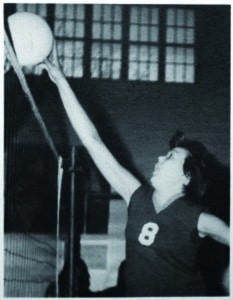
 In 1975, universities across the country began launching women’s sports programs in response to new federal regulations requiring
equal opportunities for women in athletics.
That’s when a group of HPU’s women intramural athletes stepped out in faith and asked then-president Dr. Roger Brooks to approve the creation of women’s intercollegiate sports at HPU.
“We went to the president and we asked for intercollegiate athletics,” said Melinda (Venable) Kirst ’78, who met with Dr. Brooks and played on HPU’s first volleyball team. “We said, ‘We just want to play.’”
That request launched the era of women’s sports at HPU.
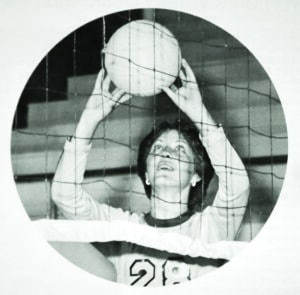 There would be no scholarships the first year, but that was OK with the players.
Maxine Hine, a physical education professor who had never coached volleyball, was named the first coach, so the coach and players were growing together.
And the first basketball coach was also a student, said Sherri Johnston ’78, who played on the first team.
Miki (Mieth) Martin ’80 came to Howard Payne a year later. She said even though there were challenges, some of them are remembered fondly.
“The years that I was there, we got a brown paper sack from the cafeteria – we had a bologna sandwich,” said Martin, while laughing about the go-to road meal. “We ate it and we survived.”
Kirst said many of their meals in the first season were paid for by Hine and her husband, George, who served as
sports information director.
And fans, at first, were few.
“Some people supported us, but it was kind of a misnomer,” Martin said. “People didn’t really know we were there. As the four years progressed, there were more fans.”
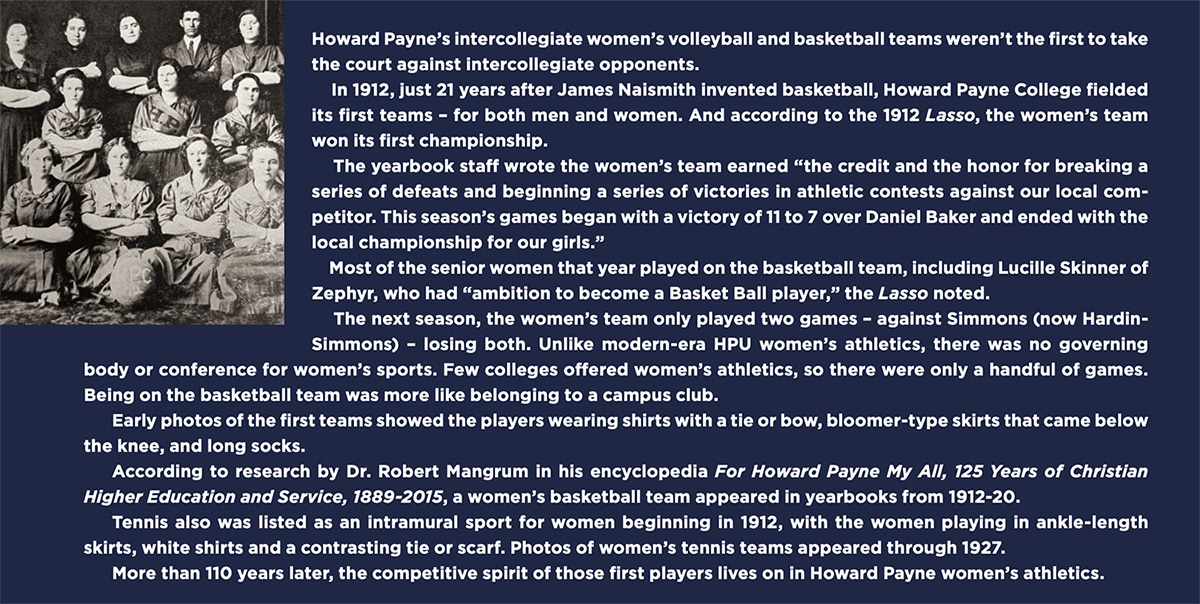
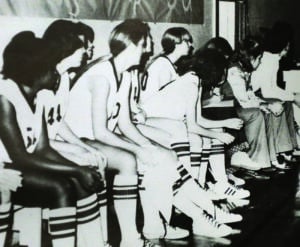 In its second year, the volleyball team made it to the AIAW (the governing body for women’s sports at the time) state tournament, Kirst said.
However, the season ended with some disappointment because travel money was unavailable.
“The second year, we had a very good team, and we qualified for small college nationals, but they wouldn’t let us go,” Kirst said. “We were very, very disappointed.”
Even with some of the challenges, the women athletes still said they wouldn’t trade their experience on the first teams for anything.
“Although the program had limited funding and basic equipment, we were just glad to play,” Johnston said. “I can’t even remember what our first-year record was.”
“We went to school there and we loved it,” Martin said. “Most of us had nothing… but we had a great time.”
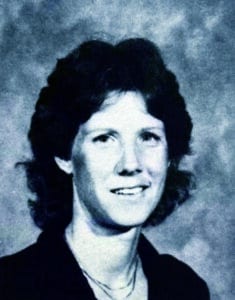 Women’s basketball graduated to a bigger stage in the early to mid-1980s with a move to the NAIA. The change meant both men’s and women’s teams competed under the small-college athletic governing body and in the Lone Star Conference.
Under the leadership of Coach Sharon Campbell, the Lady Jackets won the Lone Star Conference championship in 1982 and went to the NAIA Playoffs that year and again in 1983, when they won the NAIA District 4 championship.
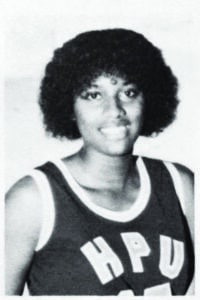
For that 1982-83 season, Campbell recruited possibly the best women’s basketball player in school history – Peggy (Taylor) Davis ’85. In just two seasons after transferring from Cisco Junior College, she still holds HPU records for most points in a season (738), most rebounds in a season (381) and most field goals in a season (300) – marks all set in 1982-83. She also became the first HPU player to earn All-American honors.
The Lone Star Conference moved from the NAIA to NCAA Division II in 1983. In 1983-84, she led the Lady Jackets to overcome a lackluster regular season and win the Lone Star Conference Tournament, earning the team a spot in the NCAA Division II tournament with a first-round game against Southeast Missouri State.
The Lady Jackets’ success earned the notice of fans not only at Howard Payne, but in Brownwood. That led to games being moved from the gym on campus to Brownwood Coliseum with the women playing doubleheaders with the men’s team.
Longtime HPU broadcaster Dallas Huston said women’s basketball had a “rocky start” in the ’70s, but one player
changed that in the 1980s.
“Peggy obviously was the one,” he said.
 The women’s sports landscape at Howard Payne changed again in the late 1980s. The school’s athletics teams joined the non-scholarship NCAA Division III Texas Intercollegiate Athletic Association (TIAA). The move put HPU on more equal footing with private schools and smaller state schools.
And it led to the volleyball team becoming a powerhouse, with TIAA championships in 1987, 1989, 1990, 1992, 1994, 1995 and 1996, with a co-championship in 1988.
Peggy (Taylor) Davis returned to her alma mater in 1988 to coach the basketball team, becoming the first of several former players who returned to HPU as coaches. Her teams were TIAA co-champions in 1989 and champions in 1990.
The move to Division III also allowed the addition of women’s track in 1988, women’s tennis a couple of years later and softball in 1998. All three sports saw early success, with the track team winning five championships in the 1990s, tennis titles in 1991 and 1996 and softball a divisional title in 2001.
“I recognized them [women’s sports] as being critically important,” said Dr. Don Newbury ’61, who was HPU president at the time during the move to Division III and the addition of the new women’s sports.
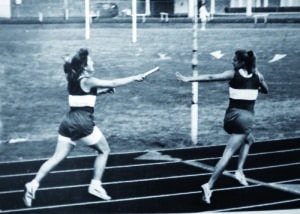 Dr. Julie (Anderson) Welker ’94 arrived at Howard Payne from tiny Rocksprings, motivated by a coach who constantly asked, “How good do you want to be?”
Recruited at the state track meet to run the 800 and the mile relay, she chose Howard Payne over larger programs after a campus visit and a personal welcome from Dr. Newbury.
Dr. Welker, now professor of communication and department chair at Howard Payne, was part of a team that won two TIAA championships and ventured into indoor track and cross country.
“Relays were always my favorite,” she said. “There’s such a sense of satisfaction when your team comes together to win something, because everybody benefits from that.”
And track helped Dr. Welker long after her running days were over.
“Working hard and putting more into it than I think I can has pushed me in my career to not just settle,” she said.
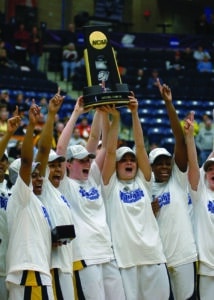 The undisputed biggest moment of 50 years of women’s sports at Howard Payne is the 2008 undefeated 33-0 NCAA Division III basketball championship.
Nicknamed “The Perfect Swarm,” the HPU women were the only undefeated basketball team in the NCAA – men or women in any classification – that season.
“I had the privilege of calling all of their games and it was one of the highlights of my life,” Huston said. “They were by far the best Lady Jacket team ever and one of the best ever in the nation at that level.”
Hope (Hohertz) Deramus ’10 was a part of it and sees the championship run as a turning point for women’s sports at Howard Payne. It raised the visibility and respect for women’s athletics on campus, helping put HPU “back on the map” through women’s basketball. It also helped establish an expectation of more equal support for men’s and women’s programs, she said.
The team had lost in the Sweet 16 round the year before and she said the players came home “sick” over the loss and immediately started working for the next season. Players stayed in Brownwood over the summer, practicing together to get better.
“We were so adamant that we wanted each of us to become better. We all knew our role and we just needed to fulfill those roles,” said Deramus, who’s now a sergeant for the Texas Department of Public Safety.
Only four of 33 games were decided by 10 or fewer points. The team had NCAA Division III National Player of the Year Meia (Daniels) Netter ’08; National Coach of the Year Chris Kielsmeier; and two All-Americans, Daniels and Stacey Blalock ’08.
“It made a huge impact and will continue to be a milestone for my entire family,” Deramus said. “You never, never will get over that feeling of the stands being full and over you at the coliseum. You felt like you were on top of the world when you were on the court.”
Huston said after the women advanced to the Final Four at the Sweet 16 regional at Brownwood Coliseum, there was no doubt about what would come next.
“We went up there fully expecting a national championship,” he said. “Those girls were special – and they still are.”
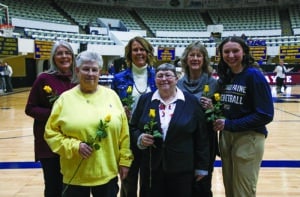 After adding golf in 2015, the last three years have brought rapid expansion and momentum to women’s sports at HPU.
Another new addition is the Woody and Miki Martin Sand Volleyball Courts on campus, with the lead gift coming from Martin and her husband, Woody Martin ’80, a former HPU football player. The couple see the gift as “Kingdom work” to draw students to campus, strengthen women’s athletics and ensure more students hear the Gospel while they’re there.
“I didn’t realize beach volleyball was becoming the thing until Dr. (Cory) Hines (’97) said many colleges were adding the sport,” she said. “I’m glad it’s something new for the girls – and I like that it’s right there on campus. People just seem to love being out there and being able to watch.”
Micah (Cisneroz) Taylor ’16, MBA ’18, who was an All-Conference volleyball and basketball player for the Lady Jackets from 2015-2017, is the new beach volleyball coach.
“Schools know they have to invest more if they want to attract the kind of recruits they’re looking for, and our current administration and coaches are really pushing for better and bigger things,” she said. “You can see it in the way Howard Payne keeps adding opportunities for women – starting beach volleyball is a great example of that commitment.”
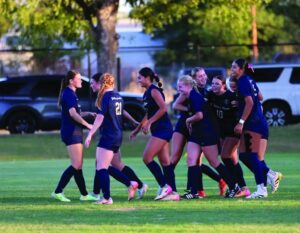 Bright said success for women’s athletes isn’t just measured on the field.
“Our student-athletes are supported through health and wellness services, mental health resources and mentoring programs that help them navigate the rigors of competition, academics and life,” he said. “There’s a strong culture of care here from coaches, teammates and staff who all play a role in helping young women grow in confidence and resilience.”
This fall, HPU will have a staff sports psychologist to help student-athletes “be the best version of themselves.”
“We aim to develop women of character who are ready for life after college,” Bright said. “Through leadership opportunities within their teams and across campus, community service initiatives and career preparation resources, women athletes build the skills that serve them long after their final game at HPU.”