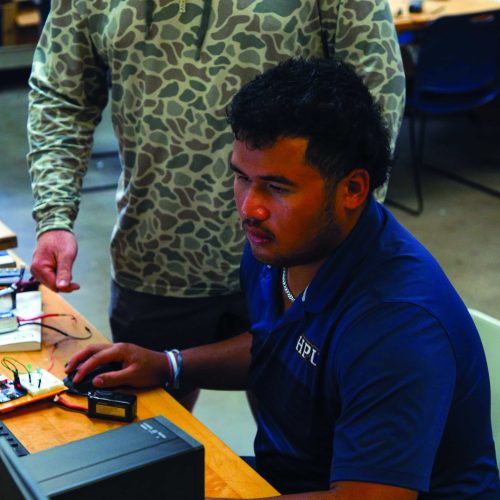
Howard Payne University’s Department of Engineering offers programs in Engineering Science, Biomedical Engineering, and Software Engineering, providing students with a strong technical foundation and opportunities to apply what they learn through hands-on projects.
Engineering students begin working on comprehensive projects early in their studies, allowing them to connect classroom concepts with practical problem-solving and real-world applications. Through project-based learning, students develop skills in design, analysis, technology, teamwork, and innovation while exploring solutions that can benefit society. Each engineering program provides a focused academic path while encouraging students to gain practical experience, strengthen their technical abilities, and prepare for future careers or advanced study in engineering.
Howard Payne University’s Department of Engineering offers programs in Engineering Science, Biomedical Engineering, and Software Engineering, combining technical education with hands-on, project-based learning. Students begin working on engineering projects early in their studies, developing practical skills while learning how engineering can be used to address real-world needs.
Through coursework, design projects, and collaborative experiences, students strengthen their abilities in problem-solving, analysis, innovation, and technical design. The programs encourage students to apply principles of mathematics, science, technology, and engineering while gaining experience that prepares them for professional careers or advanced study.
Engineering gives students the opportunity to turn ideas into practical solutions. At HPU, students develop the technical and analytical skills needed to identify problems, evaluate possible solutions, design systems and technologies, and understand how their work can affect people and society.
With programs in Engineering Science, Biomedical Engineering, and Software Engineering, students can pursue an area that aligns with their interests and career goals. Hands-on projects provide opportunities to apply classroom knowledge while developing important skills in teamwork, communication, critical thinking, and design. This combination of technical preparation and practical experience equips graduates to continue learning and growing throughout their engineering careers.
Rooted in Howard Payne University’s Christ-centered mission, the Department of Engineering encourages students to use their technical knowledge with integrity, excellence, responsibility, and a commitment to serving others. Students are challenged to consider not only whether a solution can be created, but also how their decisions and designs can responsibly benefit people and communities.
By connecting engineering education with Christian faith and ethical responsibility, students are prepared to approach their profession as an opportunity for service and stewardship. HPU seeks to equip engineering graduates to pursue excellence in their work, make thoughtful and ethical decisions, and use their abilities to serve God and humanity through innovation and responsible engineering practice.
To learn more about the values that guide the Howard Payne University community, explore our Core Values.
Bachelor of Science in Engineering Science
130 hours
Engineering Science Minor
20 hours
For complete program requirements, course descriptions, academic policies, and degree information, please refer to the Howard Payne University Academic Catalog. The catalog provides the most current and comprehensive details to help you plan your academic journey, page 166-173; 208, 210.
Bachelor of Science in Biomedical Engineering
134 hours
Biomedical Engineering Minor
22 hours
For complete program requirements, course descriptions, academic policies, and degree information, please refer to the Howard Payne University Academic Catalog. The catalog provides the most current and comprehensive details to help you plan your academic journey, page 166-173; 208, 210.
Bachelor of Science in Software Engineering
130 hours
For complete program requirements, course descriptions, academic policies, and degree information, please refer to the Howard Payne University Academic Catalog. The catalog provides the most current and comprehensive details to help you plan your academic journey, page 166-173; 208, 210.
Applied Physics Minor
20 hours
For complete program requirements, course descriptions, academic policies, and degree information, please refer to the Howard Payne University Academic Catalog. The catalog provides the most current and comprehensive details to help you plan your academic journey.
Engineering Science focuses on the general application of various combinations of mathematical and scientific principles to the analysis, evaluation, and solutions of engineering problems.
The Engineering Science B.S. degree program offers students a series of multidisciplinary courses which emphasize both understanding and integrating applications of science, technology, engineering and mathematical (STEM) concepts. The program is designed to prepare students either for immediate entry into the workforce as engineers or for pursuit of graduate studies at M.S. and/or Ph.D. levels in specific engineering disciplines of their choice. The curriculum provides a broad foundation for such disciplines along with a liberal arts education which embraces a Christian worldview.
Chair of the Department of Engineering: Dr. Phillips Agboola
Introduction
The Engineering Science B.S. degree program offers students a series of multidisciplinary courses which emphasize both understanding and integrating applications of science, technology, engineering and mathematical (STEM) concepts. The program is designed to prepare students either for immediate entry into the workforce or for pursuit of graduate degrees in specific engineering disciplines of their choice. The curriculum provides a broad foundation for such disciplines along with an education which embraces a Christian worldview.
In addition to taking core courses in mathematics, physics, chemistry, computer information systems, and technical writing, students will study the foundational engineering principles of statics, dynamics, mechanics of materials, thermodynamics, electrical circuit analysis, and microelectronic incorporating sound economical standards and ethical responsibility. During their senior year, all students will select a focus area of study and complete a design project that integrates the principles of research, process, and analysis as applied to engineering.
Since it is necessary for potential engineering science students to have adequate high school preparation for this program, it is highly recommended that they take high school physics, chemistry, and four years of mathematics in preparation for the pursuit of this degree. Mathematical proficiency is essential to engineering and placement tests are given to all incoming freshmen, and those who do not qualify to begin Calculus I will be required to take additional leveling mathematics courses.
Mission Statement for Engineering Science
The Howard Payne University Engineering Science Program prepares liberal arts students to serve God and humanity in a Christ-centered manner by producing graduates with the knowledge and skills; personal and professional integrity; and intellectual inquisitiveness to affect the world through an engineering profession.
Program Goal
Engineering Science graduates will be equipped for success in the career path of their choosing; and be capable of pursuing an advanced degree and/ or a career where they may attain job satisfaction and professional growth while serving God and humanity.
Program Educational Objectives (PEOs)
For the Engineering Science program, the desired student competencies are as follows:
Identify, formulate, and solve engineering problems by applying principles of science, technology, engineering, and mathematics.
Apply both analysis and synthesis in the engineering design process, resulting in designs that meet desired needs.
Develop and conduct appropriate experimentation, analyze and interpret data, and use engineering judgment to draw conclusions.
Communicate effectively with a range of audiences.
Recognize ethical and professional responsibilities in engineering situations and make informed judgments, which must consider the impact of engineering solutions in global, economic, environmental, and societal contexts.
Recognize the ongoing need for additional knowledge and locate, evaluate, integrate, and apply this knowledge appropriately.
An ability to function effectively on teams that establish goals, plan tasks, meet deadlines, and analyze risk and uncertainty.
Program Insights

Artificial Intelligence (AI) Engineer

Computer Programmers

Robotics Engineers

Biomedical Engineer

Mechanical / Electrical Engineer

U.S. Army or Navy Engineers

Teaching Physical
Education & Coaching
Students interested in pursuing
graduate studies in engineering are
provided with broad opportunities to
engage in comprehensive research
and development engineering
projects at a very early stage in any
of the three engineering programs
at HPU. These projects usually result
in the broad dissemination of the
results in the media, international
conferences, or journals.
Upon graduation, students can join
the industry and register as Engineers in
Training with the Texas Board of
Professional Engineers and Land
Surveyors (TBPELS), become patent
agents (engineering science graduates
only), or decide to pursue graduate
studies in a specific area of engineering.

Alumni Testimonial
“God brought me to Howard Payne and to the great people I met there during my studies. I am lucky to have had the privileges I enjoyed during my time there that aided me in pursuing a field that helps others.”
Ryan Robertson ’24

Scholarships
95% of HPU students receive financial aid.
We’re passionate about making your college experience financially accessible. Our dedicated Financial Aid team will work diligently with you to explore every available opportunity and help make your HPU education affordable.