


Students gain hands-on experience with constitutional law while building skills that extend far beyond the courtroom
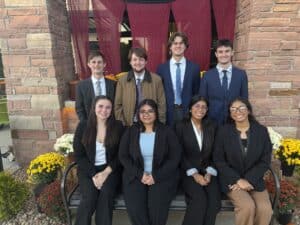
BROWNWOOD – November 13, 2026 – Howard Payne University’s (HPU) Moot Court team recently demonstrated its preparation and competitive ability at an invitational tournament hosted by Colorado Christian University.
The team of Rylie Burden and Adriaan Lafferty advanced to the semifinals, finishing fourth overall after a close 3-2 decision. The team of Andrew Mathis and Caden Sandlin advanced to the octofinal round, finishing among the competition’s top 16 teams. Teams consisting of Sharon Herrera and Brock Horton, and Shadia Herrera and Gabriela Pena, also represented HPU at the tournament.
The team’s success reflects HPU’s longstanding involvement in undergraduate Moot Court. HPU’s teams have won two national championships, in 2002 and 2015, in the American Moot Court Association (AMCA).
“One of the greatest benefits of Moot Court is that students learn how to think critically rather than simply memorize information,” said Kenan Boland, assistant professor of government and coach of HPU’s Moot Court team. “They must analyze complex legal questions, evaluate competing interpretations of the Constitution and develop persuasive arguments supported by legal precedent.”
Moot Court is an academic competition that simulates proceedings before an appellate court, similar to the United States Supreme Court. Students work in pairs to prepare arguments addressing constitutional questions, drawing on Supreme Court decisions and legal precedent to support their positions. During competition, students present their arguments before a panel of judges who interrupt with questions, challenge their interpretations and introduce hypothetical situations that require students to think critically and respond in the moment.
The AMCA organizes undergraduate Moot Court competitions across the country. Each year, the AMCA releases a hypothetical case involving two constitutional issues. Students spend months studying the case, researching relevant legal decisions and preparing arguments for both sides.
Because the competition does not have divisions, HPU competes against universities of all sizes, including the University of Texas, Texas A&M University, and even schools such as Yale and Harvard.
Preparing both sides of a case also encourages students to consider perspectives that may differ from their own. Through the process, they learn that constitutional questions are often complicated and that reasonable legal arguments can exist on opposing sides of an issue.
Boland said beyond strengthening their understanding of constitutional law, Moot Court helps students develop skills that can benefit them in a variety of professional fields.

“Students improve their public speaking abilities, learn to communicate complicated ideas clearly and become more comfortable responding to difficult questions under pressure,” Boland said. “They develop analytical skills, learn to work collaboratively with a partner and gain confidence in their ability to defend a position using evidence and reasoning. These skills are valuable in virtually any career, whether students pursue law, government, business, education or another profession.”
Lafferty, a sophomore jurisprudence and Guy D. Newman Honors Academy major from Elgin, and member of HPU’s Moot Court team, said the experience requires extensive preparation and the ability to think quickly under pressure.
“To be successful, students must master thousands of pages of case law and be able to apply it on the fly when justices interrupt their argument to ask questions,” said Lafferty. “Thus, Moot Court not only tests constitutional analysis, but also reading comprehension and other forensic skills.”
Although Moot Court is an excellent opportunity for students considering law school, Boland said that students do not have to pursue a legal career to benefit. Students who enjoy discussing current issues, examining different perspectives, debating and learning about the Constitution can all gain valuable experience through participation.
HPU’s team will next compete in regional AMCA tournaments, with one event taking place at Texas A&M Law School in Fort Worth and another at Eastern Michigan University in Ypsilanti, Michigan. Teams that finish in the top eight at the regional level advance to the next stage of competition, which includes the top 128 schools in the country. The national tournament will ultimately feature the top 32 teams in the country.
For more information about HPU’s Moot Court team, contact Kenan Boland at kboland@hputx.edu.
ABOUT HOWARD PAYNE UNIVERSITY
Howard Payne University, founded in 1889, is a Christ-centered liberal arts university in Brownwood, Texas, dedicated to preparing students for lives of faith, leadership and service. With more than 100 majors, minors and pre-professional programs across six schools, serving three locations, HPU combines academic excellence with meaningful personal connection in a close-knit campus community.
Guided by its five core values — centered on Christ, focused on community, called to service, committed to excellence and dedicated to stewardship — Howard Payne prepares students through rigorous academic programs, vibrant student life, competitive athletics and service opportunities that equip graduates to make an impact in their communities and professions.